Open your inbox on a Tuesday and count your jobs. There's a menu board for a café. There are two event posters, and one of them is due on Friday. There's a sheet of packaging stickers for a bakery, the monthly socials for a running club, and a quote you promised someone on Instagram three days ago. None of them is big.
But each one has its own email thread, its own price and its own round of small changes. By Thursday, you feel overwhelmed. You can't remember which poster got the new date, or who still owes you their logo file.
I run a creative studio and I build a client tool called Chord, so I'll be upfront: Chord is mine, and I'll talk about it later in this post. First, I want to give you the checklist I'd hand any graphic designer who's shopping for a CRM.
I wrote this for freelance graphic designers and small studios who make posters, social graphics, packaging and print, often for the same few clients. If you mostly do long brand identity projects, my post for brand designers will suit you better.
1. Quoting repeat work in minutes
As a graphic designer, you've priced most of your jobs before. An event poster is an event poster. A social media kit is a social media kit.
Still, many of us write every quote from scratch. We copy last month's PDF and hope we changed the client's name everywhere. When a job is worth a few hundred dollars, twenty minutes of quoting eats into what you earn from it.
So look for a CRM that saves your packages, each with its price and line items. Then look for proposal templates that already hold your intro, timeline and FAQs. When a new enquiry comes in, you should only need to pick the right packages.
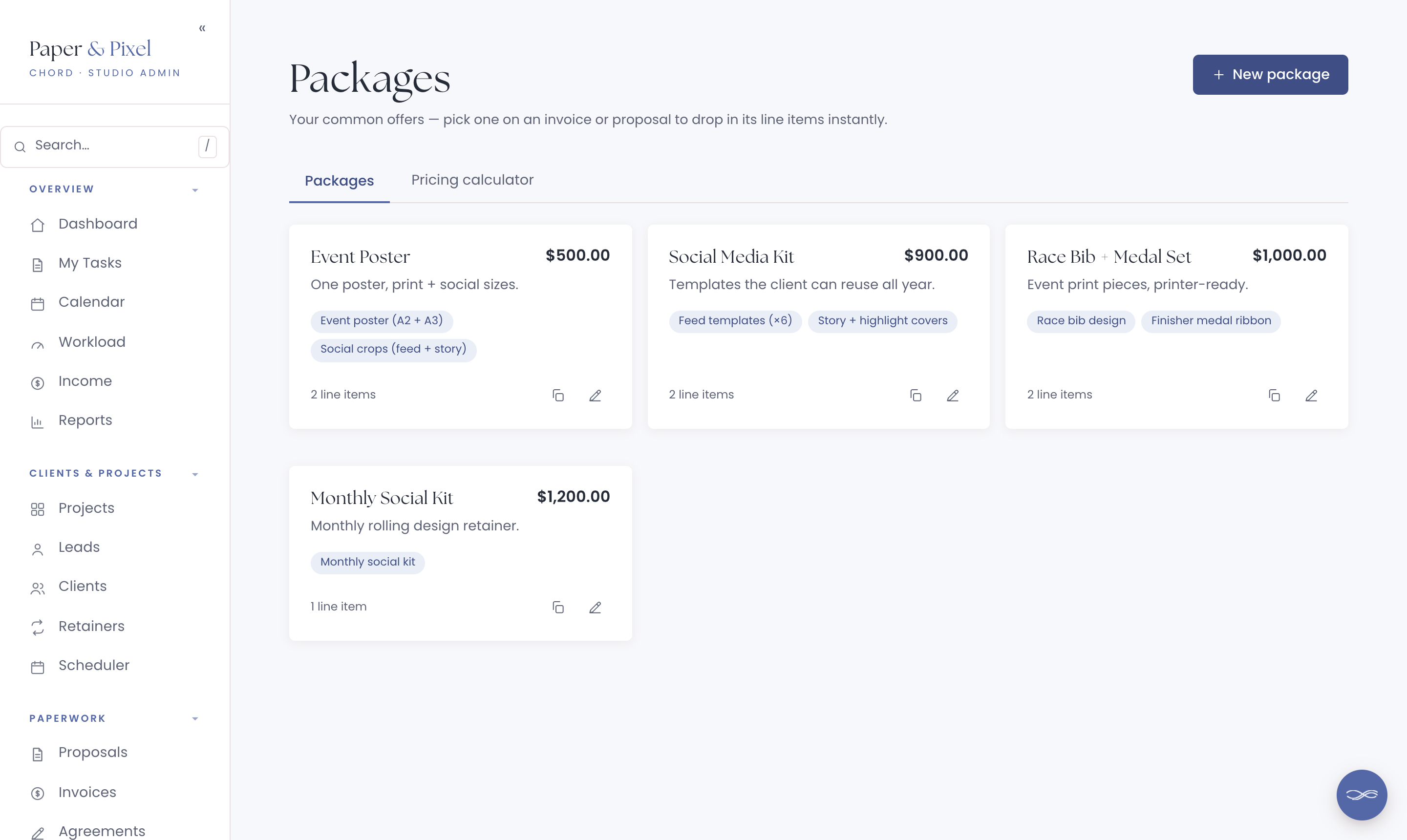
In Chord, you save each offer as a package with its price and line items. You start a proposal from your template, and the intro, timeline and FAQs are already there. Then you add the packages for this job and send it.
For small jobs that don't need a proposal, you can drop the same packages straight into an invoice. And when a client accepts a bigger proposal, Chord can take them straight on to your agreement and deposit invoice.
2. Monthly work that runs on a checklist
Many graphic designers have one or two clients on a monthly plan. You might make their social posts, their newsletter header or their event calendar every month.
This work pays the bills, but it's also easy to lose track of. It doesn't feel like a project, so you don't watch it like one. Before you know it, the ten hours you sold each month have turned into fifteen.
Look for a CRM that treats a retainer as its own thing. You want a list of the work you do each month, the hours each piece takes, and an invoice that goes out every month without you having to remember it.
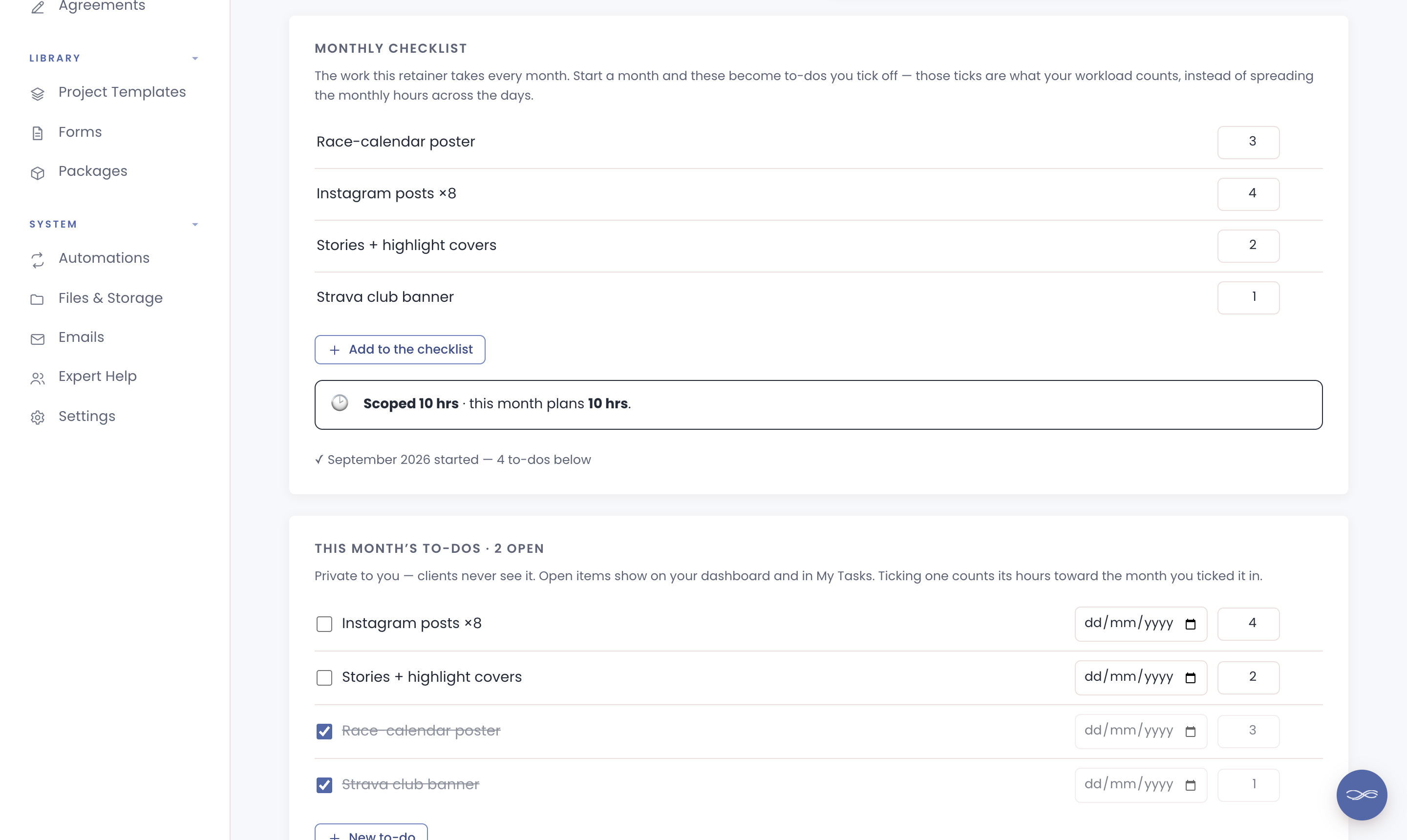
In Chord, you give a retainer a monthly checklist. For a running club, that might be a race-calendar poster, eight posts and a set of stories, each with its hours.
When you start a new month, the checklist turns into to-dos. As you tick them off, the hours count toward your workload.
Chord also shows the hours you sold next to the hours you've planned. If you're giving away more time than you charge for, you'll see it early.
Chord can raise the monthly invoice for you, either as a draft to check or sent straight away. You can also share the retainer in your client's portal, so they can see what's included each month. Retainers come with the Pro plan.
3. Pin-point feedback on the artboard
Your client emails you: "Can you make the date bigger?" But which date? The one on the poster, the story or the race bib?
Graphic design feedback is almost always about one spot on one piece. Yet it usually arrives as a list in an email, a voice note, or a screenshot with a red circle drawn on it.
What you need is a tool with pinned comments. Your client taps the exact spot, and the comment stays attached to it. You reply right beside it, so nobody has to guess what they meant.
It also helps if the whole set can go on one proof. That way, one campaign stays in one thread.
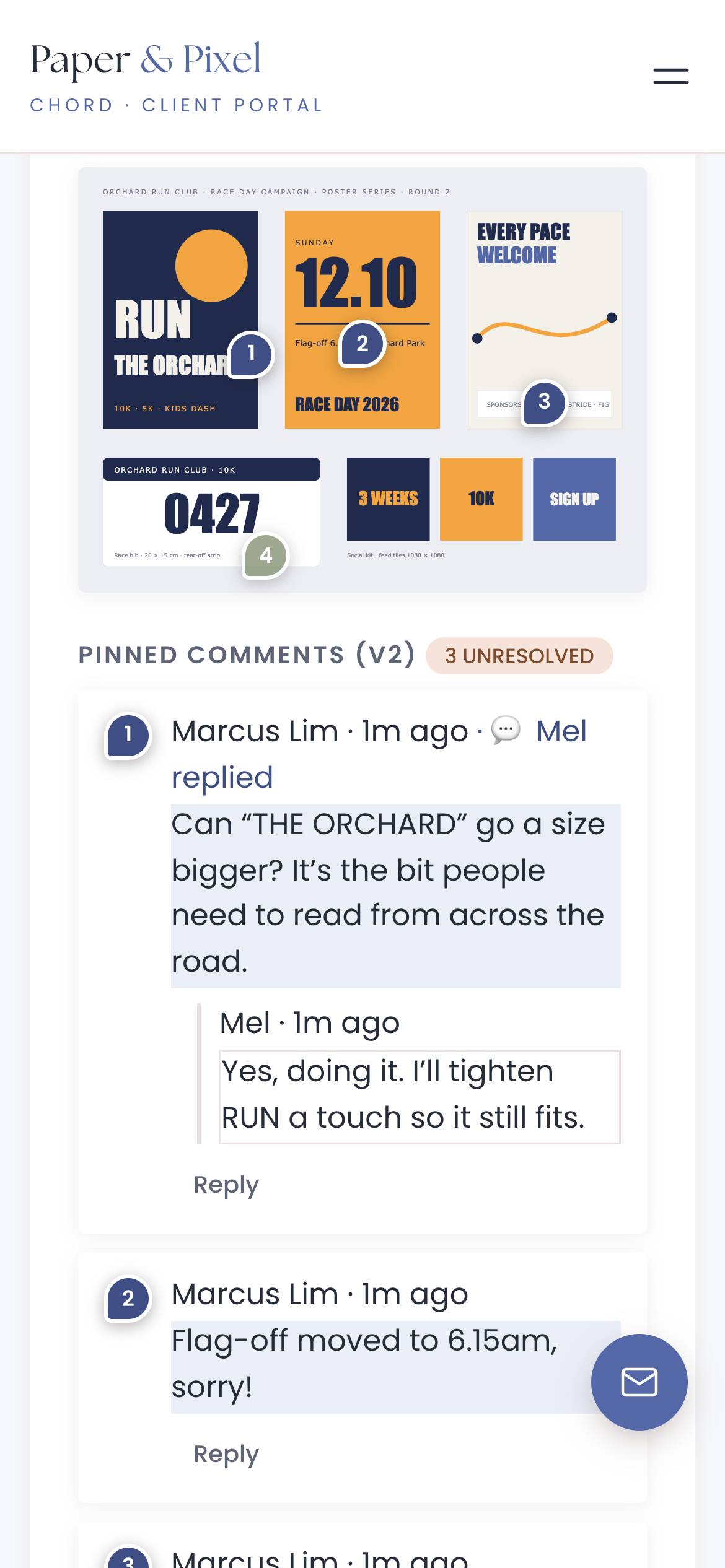
In Chord, proofing is built into the client portal. You upload the round, with the posters, bib and social tiles together if you like. Your client clicks or taps anywhere on the artwork to leave a comment.
You reply in the thread and mark each comment done once it's in the next version. Chord also counts how many rounds of changes your client has used. Your client doesn't need another login, and you don't need to pay for a separate proofing tool.
4. Lots of small clients, one tidy pipeline
Small jobs mean lots of clients. They also mean lots of enquiries, from DMs, referrals and the form on your website.
The enquiries you lose are rarely the big ones. It's the $400 menu board you meant to follow up on and forgot.
Old clients come back, too. When the bakery asks for Christmas stickers six months later, you'll want to know what you quoted them last time.
Look for a pipeline that puts every enquiry in one place, with its value and where it came from. You want follow-up reminders, and a contact history that stays with the person when a lead becomes a client.
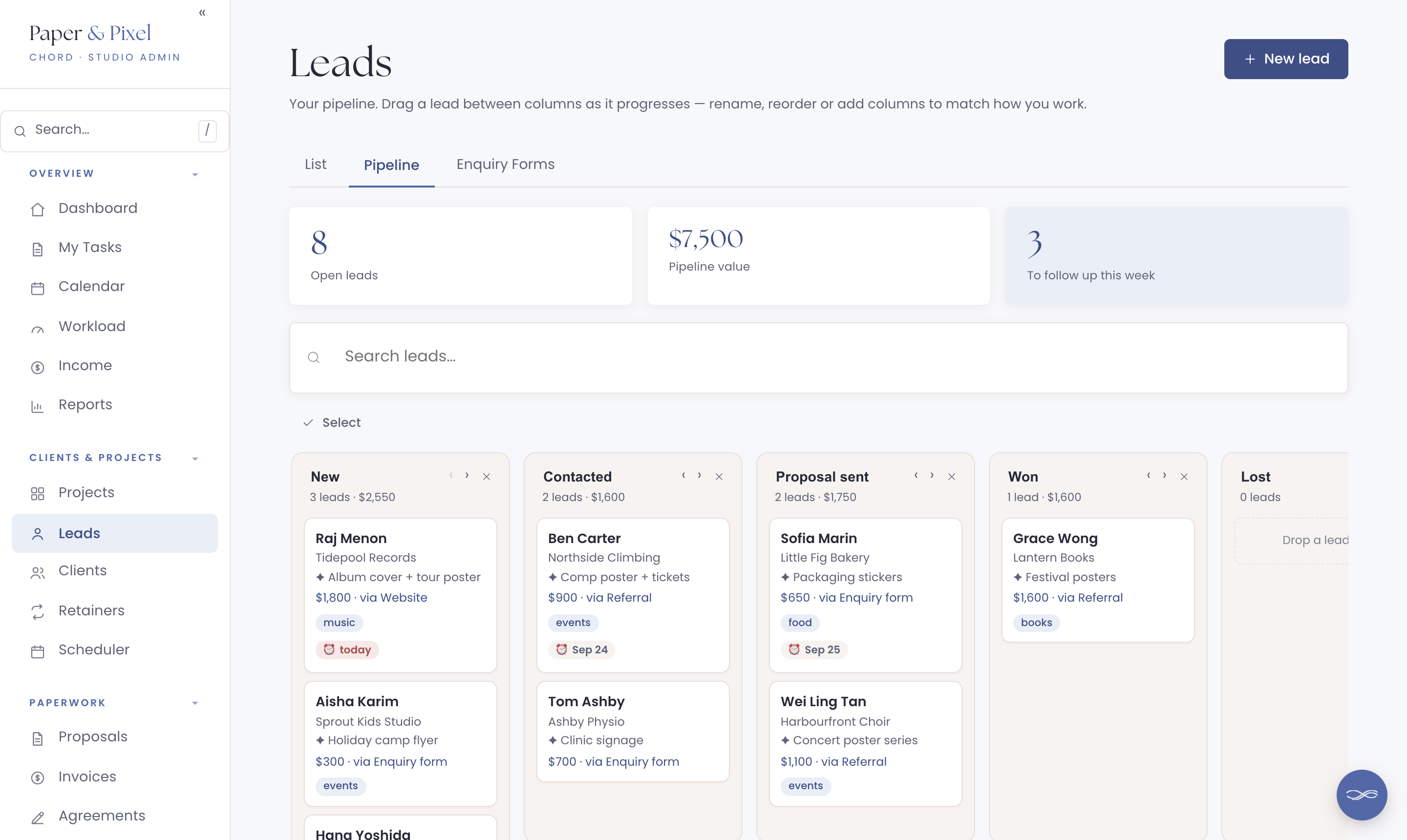
In Chord, your leads sit on a pipeline board that you can rename and rearrange. Each card shows the job's value, where the lead came from, your tags and a follow-up date. The top of the board tells you how many people you need to follow up with this week.
When someone fills in the enquiry form on your website, Chord adds them as a lead for you. You log calls, emails and notes as you go.
When you win a lead, their history moves onto their client record. From then on, Chord logs the emails you send them there too.
5. Knowing what fits this week
Small jobs have a trap: each one looks like it fits. A poster takes a day. Stickers take an afternoon.
Then you say yes to four of them in the same week as a campaign deadline, and you end up working on Saturday.
To avoid that, you need to see how full your week is when the enquiry comes in. Then you still have time to offer a later date.
Look for a CRM that tracks the hours on every job, spreads them across the days you'll do the work, and compares them with what you can really handle.
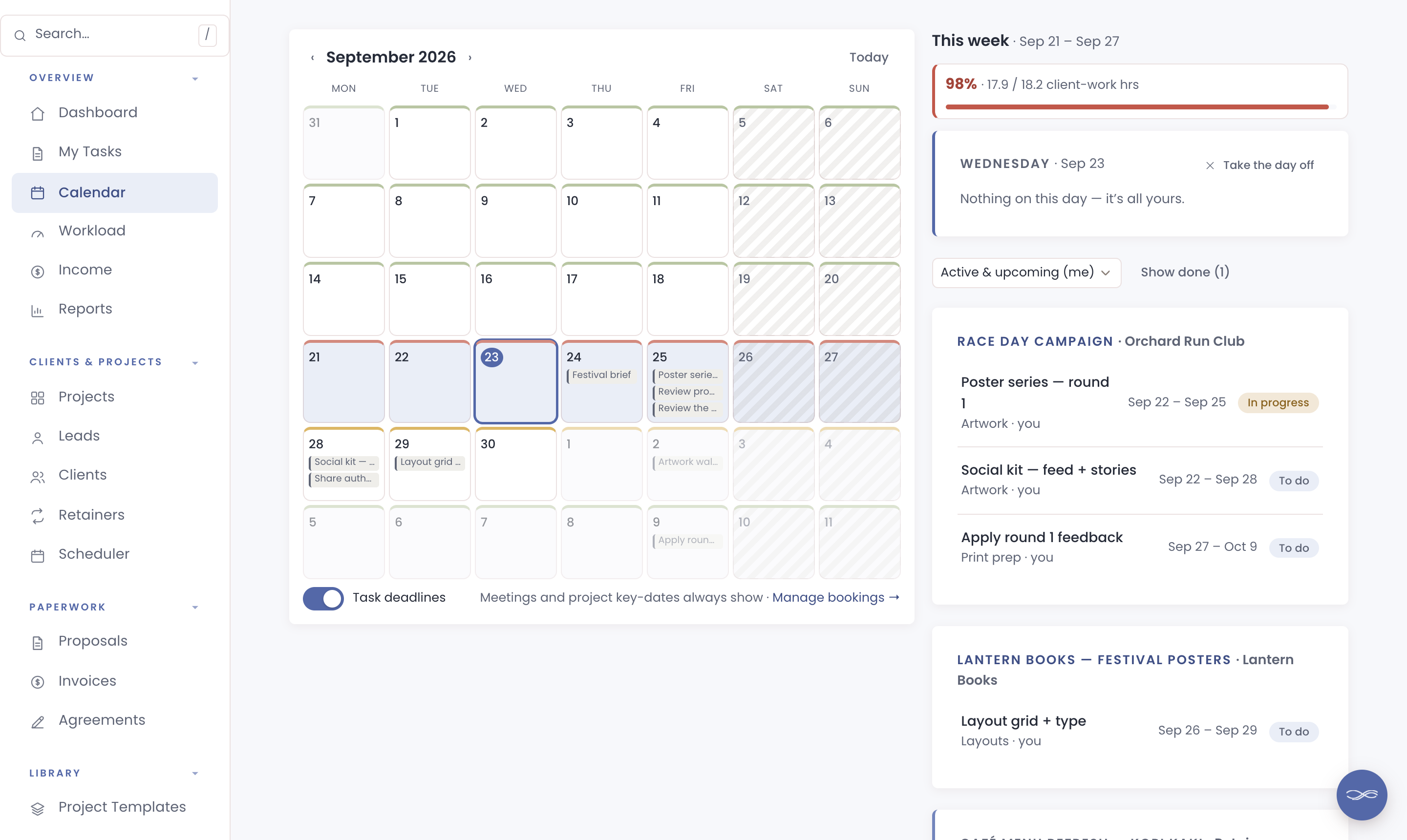
In Chord, you set how many hours of client work you can take on each month. Chord spreads that across the days you actually work. Then it adds up the hours from your projects and retainers, day by day.
Every week on your calendar gets a coloured stripe. It's green while you have room, amber once you pass 75%, and red once you pass 90%.
When someone asks for a quick poster, you can use the capacity checker. You enter the rough hours and dates, and Chord shows you whether the job would overload you and the next date it would fit. That way, you offer a date you know you can keep.
6. A plan that flexes with your seasons
One of my pet peeves: when you're at peak season, you pay for tools that expand your capacity. A lot of those tools lock you in, and then you find yourself in low season still paying for them, and now they're very expensive. Most software pricing assumes your business runs the same way every single month, but creative work doesn't.
That's why, when I built Chord, I wanted two plans you can switch between at any time. Starter at US$9 covers one active project at a time and 1 GB of storage. It doesn't include retainers, reports or sending email from your own domain, which makes it right for a one-project-at-a-time pace or a slower season.
When the work stacks up, move to Pro at US$29: unlimited projects and clients, retainers, reports, 10 GB of storage and sending email from your own domain. When things slow down again, drop back to Starter with no penalty. I made it this way deliberately, so Chord flexes with you through every season of your business.
The honest comparison
Most graphic designers choose between the freelancer all-in-one tools. Some run their studio from a time tracker instead. Here are the monthly prices as I write this:
| Tool | Starts at (US$/mo) | Pricing model | Worth knowing |
|---|---|---|---|
| Bonsai | $15 | Per user, tiered | Invoices and contracts start at $25 |
| Dubsado | $35 | Flat plans, 3 users included | Deepest automations, long setup |
| HoneyBook | $36 | Flat plans | Payments in US, Canada, UK and Australia |
| Moxie | $12 | Flat plans | Client portal starts on Pro ($25) |
| Plutio | $19 | Flat plans, capped by active clients | Core allows 9 active clients |
| Harvest | $11 | Per seat, plus usage fees | Time tracking and invoicing, no portal |
| Chord | $9 Starter / $29 Pro | Flat plans | First month of Pro US$1 with code TRIAL |
Based on published pricing as of September 2026, in US dollars, billed monthly (most tools discount annual plans). Check each site for current plans.
Bonsai charges per user, starting at US$15 a month. That entry plan doesn't include invoices, contracts, proposals or the client portal; you get those on the Essentials plan at US$25. If you want expense and tax tracking in the same tool, Bonsai is strong there.
Dubsado is the automation powerhouse. It starts at US$35 a month, or about US$28 if you pay yearly, and it includes three users. Its forms and workflows go deep, but setting them up takes a lot of time.
HoneyBook is the polished all-rounder, at US$36 a month or US$29 if you pay yearly. Its online payments only work in the US, Canada, the UK and Australia, so check your country first.
Moxie is the best value, at US$12 a month for one person, and every plan includes time tracking. You need the Pro plan, at US$25, for the branded client portal.
Plutio starts at US$19 a month and includes proposals, contracts, invoices and a client portal. But its Core plan only allows nine active clients. If you run lots of small jobs, you can hit that limit in a busy month.
Harvest is a time tracker first, at US$11 per person a month, with invoicing built in. It has no proposals, contracts or client portal. Since 2026, it also charges usage fees for invoices, projects and clients, and those add up when you run lots of small jobs.
And then there's Chord, which I built. I'm a working creative, and I built it around the six things in this post.
I'll be honest about two gaps. Chord doesn't do your accounting or taxes, so Bonsai is a better fit if you need that. Chord also plans your hours instead of timing them, so if you bill by tracked time, Moxie or Harvest will suit you better.
Setting up Chord takes a couple of hours, and your clients never need a password.
How to choose
The table gives you a shortlist, but you still have to choose.
So take last month and walk it through each tool you're trying. Include the quick jobs, the monthly client, the campaign that needed an extra round and the enquiry you forgot to answer.
Then pick the CRM that still makes sense on your busiest Tuesday.
If you'd like to try that in Chord, you can start in about ten minutes.