Most of us don't really have weeks. We have a long undifferentiated stretch of work with some deadlines poking out of it, and we treat every seven days the same — the same optimism about what will fit, the same yes to the coffee, the same 11pm finish when it doesn't.
Then a Tuesday arrives where three things fall due at once and it feels like bad luck. It usually isn't. It was visible a fortnight ago, if anyone had been looking.
The most useful change I've made to how I run my studio isn't a system or an app. It's a habit: before the week starts, I decide what kind of week it is. There are only three.
Green: the week with room in it
A green week has space you haven't sold yet. Green isn't a holiday; it's a week where the committed work sits under what you can carry.
This is the week for the things that only ever happen when you have slack. Say yes to the networking evening. Take the coffee with the person whose work you like, with no agenda. Write the case study. Send the follow-up to the client you never heard back from in April.
Green weeks are also when you take on more work — and this is the part worth being deliberate about. Most of us say yes in the week the enquiry arrives, which has nothing to do with the week the work would actually happen.
Here's what that looks like in practice. At a networking event recently, someone asked me for a one-to-one. I opened my calendar there and then. The next few weeks were red — but the third week of September was green. So I offered her that date, clearly, without the usual hedging.
I know I'll show up to it. No resentment, no apologetic "so sorry, something's come up" three days before. I've had too many meetings pushed back by people who took on more client work than they could handle. Once it has happened a few times, you stop believing the date. Offering the one I can actually keep is worth more than offering the soonest one.
Amber: the week to protect your evenings
An amber week is full but not overflowing. The work fits — as long as nothing goes wrong.
The mistake with amber weeks is treating them like green ones. They look survivable on Monday, so you add one more thing: a call, a favour, a quick turnaround for someone you like. Then a client comes back with more feedback than expected, and the buffer you were relying on turns out to have been the evening you'd planned to stop.
So in an amber week I protect the edges rather than the middle. No new commitments. Nothing that needs me after six. Meetings grouped rather than sprinkled. If someone asks for something small, it goes in next week — and because I can see that next week has room, saying so needs no hesitation.
That's the practical benefit of naming the week. "Not this week, but I can do Tuesday the 9th" is a completely different sentence from "I'm swamped, sorry."
Red: the week you defend
A red week is over capacity. There is more committed work than there are hours to do it in, and something is going to give.
The instinct is to work harder. What actually helps is smaller and duller: the routines get more non-negotiable, not less. Sleep early. Eat to support your energy rather than whatever is nearest. Keep the workouts — they're the first thing to look optional and the last thing you should drop. And say no to everything that isn't already promised: the random coffees, the extra meetings, the small favour that costs an hour you don't have.
I also use it as a heads-up at home. If the week is red, my husband gets told — partly so the evenings are planned around it, and partly so my mood arrives with a warning label rather than as a surprise.
Say no early, too. Move what can be moved while there's still notice to give. Tell the client on Monday that Thursday is tight, rather than at 6pm on Thursday.
The point of naming a red week isn't to feel bad about it. Some weeks should be red: a launch, a shoot, an intensive. Red is only a problem when it's a surprise, or when it's every week.
The catch
All of this depends on knowing what colour the week is before you're in it. Which is where the habit usually dies — because working that out by hand means adding up hours across projects, remembering which stage runs into which, and subtracting the days you're not working. Nobody does that on a Sunday evening.
So we built it into Chord.
What this looks like in Chord
Every week on your calendar carries a coloured stripe: green while you have room, amber past 75% of your capacity, red past 90%.
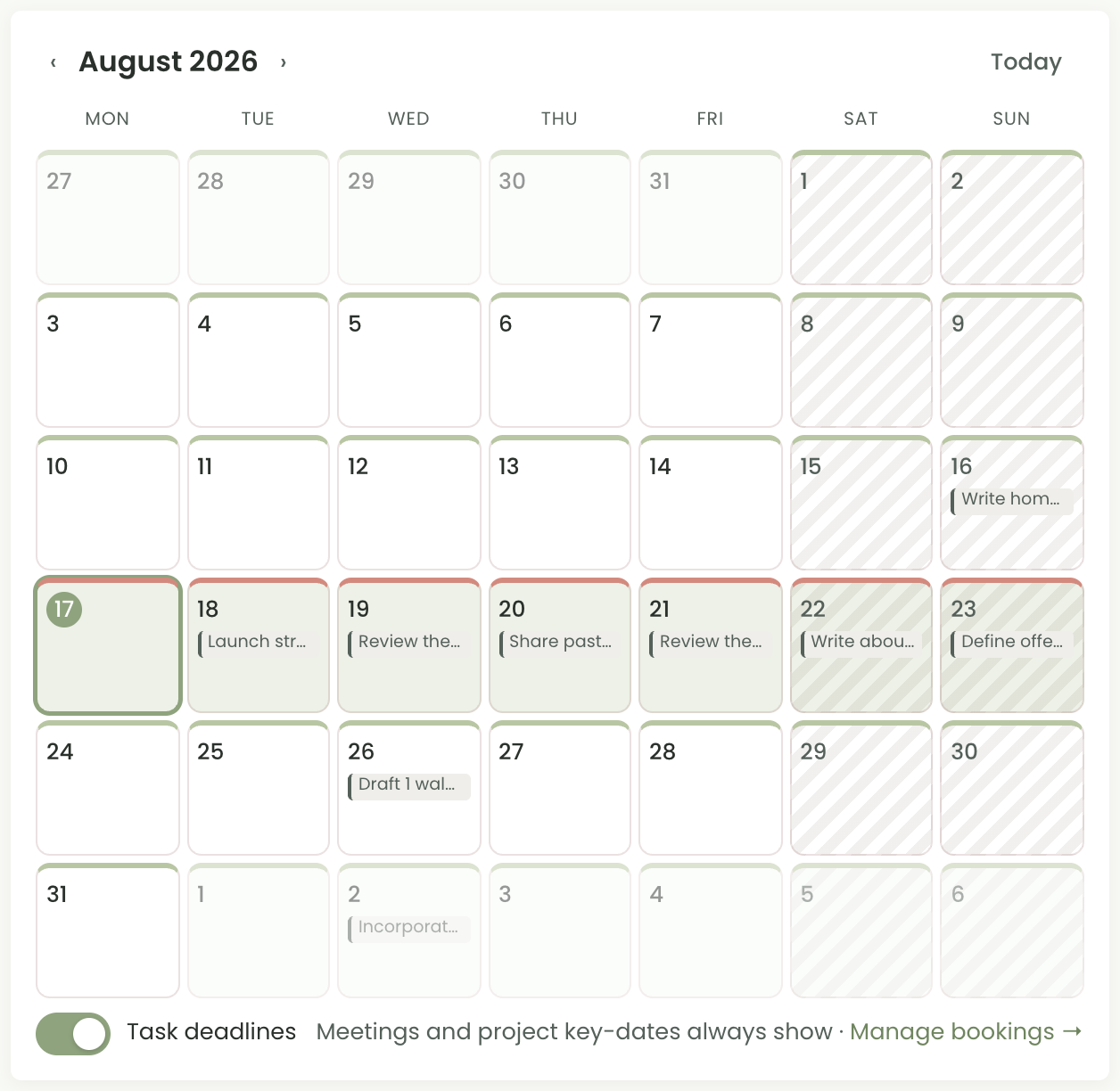
Click any week and you get the number behind the colour.


A few things make those numbers honest rather than decorative. The capacity is your number — the hours of real client work you can carry in a typical month, set once. It's divided across the days you actually work, so a week with a public holiday in it has less room than a full one, automatically. Project hours spread across the days a stage runs rather than piling onto its deadline. And retainers count, because ongoing work is still work.
There's a checker for the question that started all this, too: give it the rough hours and dates of a job you're considering, and it shows you what those weeks would look like if you said yes — before you say it. That side of things has its own post here.
None of this makes the work smaller. It just means the shape of your month stops being a surprise, and the word "no" starts arriving on time.