Scope creep almost never arrives as a big ask. It arrives as "just one more tiny tweak" — five times, across three email threads, until you're two rounds past what you quoted and quietly resenting a client you actually like.
I've been on the losing end of that more times than I'd admit. The problem was never the client. It was that "how many rounds are we on?" had no honest answer, so the line was mine alone to defend, over and over. I wanted the tool to hold that line with me.
Feedback where the work lives
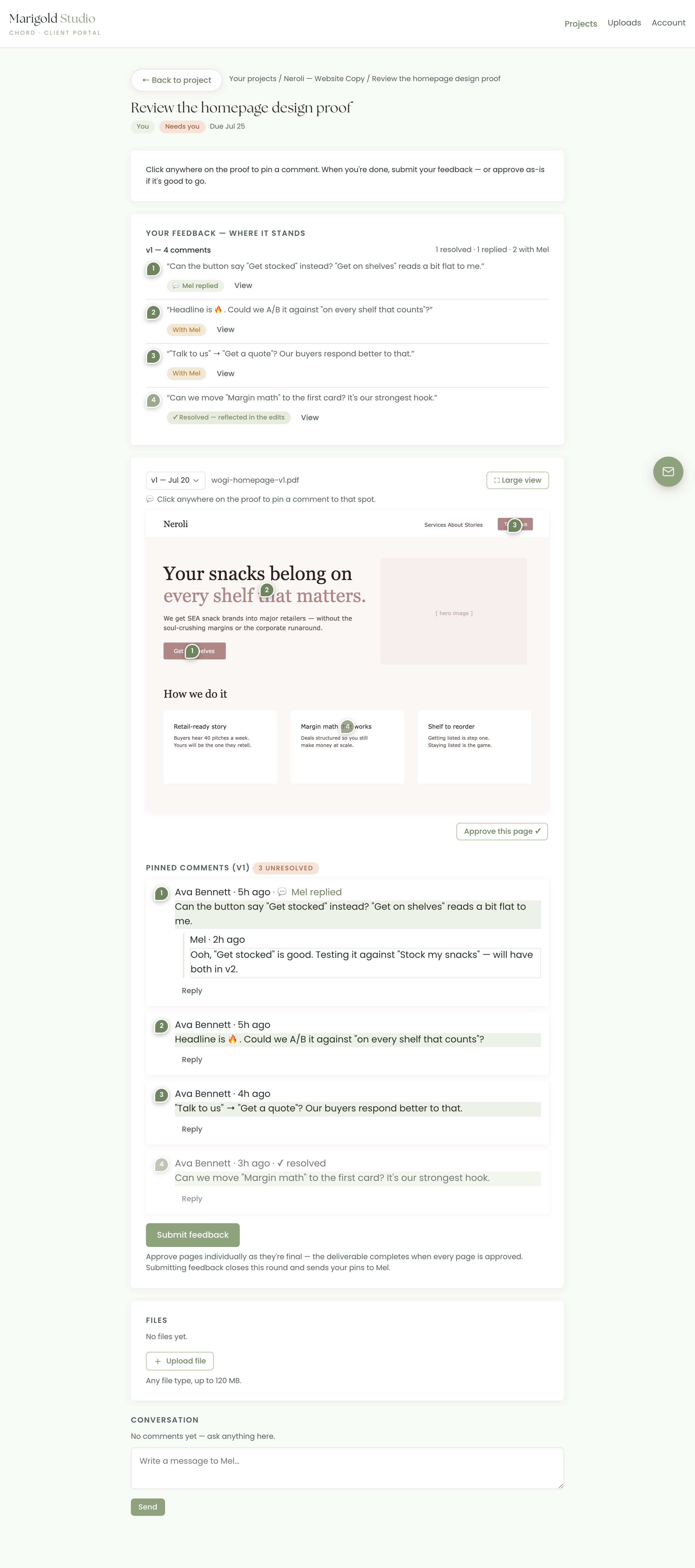
In Chord, clients leave feedback by pinning comments directly on the work — the design, the document, the proof — not scattered across email, WhatsApp and a separate markup app. Every note has context: what it's about, which version, which stage. Nothing gets lost between rounds, and you're never reconstructing feedback from six places at 9pm.
Every round is counted
This is the quiet superpower. Chord counts your revision rounds, out in the open, where both of you can see them. So when you're on the final included round, it's not a difficult conversation you have to initiate — it's simply a fact already on the screen. "This is round two of two" does the boundary-setting for you, calmly and without confrontation.
And if a piece of work doesn't run in rounds at all? One switch turns revision tracking off entirely. Chord bends to how you actually work, rather than the other way round.
Boundaries are a mental-health feature
We don't usually talk about scope in the same breath as wellbeing, but for a creative business they're the same conversation. Unpaid over-delivery is time stolen from rest, from other clients, from the work you're proud of. A CRM for creatives that helps you contain feedback isn't just protecting your margin — it's protecting your evenings, and the version of you that shows up to the next project.
You'll still say yes to the odd extra tweak, because you're generous and human. The point is that it becomes a choice you make, out loud, instead of a slow leak you only notice once you're tired.